
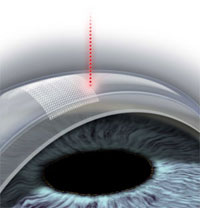
LASIK utilizes the Excimer Laser to reshape the corneal surface of the eye. LASIK is used to treat low to high amounts of nearsightedness, astigmatism, and farsightedness. LASIK combines the computer controlled precision of the Excimer Laser with the benefits of another type of refractive surgery called Lamellar Keratoplasty (a procedure where an instrument known as a microkeratome - Hansatome makes a small flap in the outer layer of the cornea).
LASIK treats the inner tissue of the cornea. Throughout the LASIK procedure, you are awake. The doctor gives you some drops to numb your eyes so that throughout the procedure you are comfortable. Next, a corneal flap is created using the microkeratome. The "flap" remains attached on one edge.
Then the cool light rays of the Excimer Laser gently sculpt the internal corneal tissue to the correct refractive power. The corneal flap is then laid back in its original position. Due to the cornea's extraordinary natural bonding qualities, stitches are rarely required. After the procedure, you will leave with a clear eye shield and eye drops to help your eye heal. Your vision might remain blurry for a few days. Most people return to work within 48 hours.
We are committed to helping you decide whether refractive surgery is right for you. We are available and eager to answer your questions as you consider whether this procedure is right for you.
Refractive surgery (LASIK) is performed as an outpatient procedure at a local "eye" surgery center with a specially equipped operating room designed for Refractive Laser Procedures and is certified by the Accreditation Association for Ambulatory Health Care, Inc. (AAAHC), through a stringent qualifying process.
Many patients with myopia or astigmatism feel visually and socially limited in their everyday life by their dependence on eyeglasses or contact lenses. Some wish to be free of the tedious tasks of caring for and maintaining contact lenses, of purchasing lenses, solutions, etc.
Some elect to have surgery for occupational reasons. Still others may have myopia or astigmatism as a result of previous, unrelated eye surgery, such as cataract or corneal transplant surgery. Such patients may possibly be corrected with refractive surgery (LASIK).
Even if patients are ecstatic about the results of their surgery, some still rely on prescription eye wear for certain visual tasks such as night driving, bright light conditions, and reading. Thus LASIK may not totally eliminate your need for optical correction, but it will likely make you less dependent on that correction.